On April 1, 2026, HFI Pyrotechnics Inc. purchased nearly 2,500 acres of provincially owned land, the first phase of a plan to return the entire 10,000-acre Edwardsburgh Land Bank to local control. The company employs more than 120 people and that number is set to grow. Prime Minister Carney’s defence procurement expansion giving it momentum, but Edwardsburgh-Cardinal was already positioned to support a transaction at this scale.
Edwardsburgh-Cardinal is one of seven partner municipalities in the SLCEDC’s St. Lawrence Corridor. It sits in Leeds and Grenville County along the St. Lawrence River, about an hour south of Ottawa and 90 minutes west of Montreal with the 401 and 416 meeting nearby. The Port of Johnstown sits close on the township’s southern edge.
A Certified Site at the Centre of It
The Johnstown Industrial Park holds one of Ontario’s Investment Ready: Certified Site designations. This is a provincial credential confirming that the property is fully serviced, free of constraints through applicable assessments. For site selectors this means the work to set the land up for use has already been done. This industrial park covers 306 acres with frontage on County Road 2 and two access points off Newport Drive. Existing users of the park include transport companies, warehousing businesses, food processing, renewable energy firms, and more. Cardinal, the township’s namesake village on the St. Lawrence River, has been a manufacturing community since the 19th century.
The Access That Changes the Math
The Port of Johnstown sits on the townships southern edge giving access to the St. Lawrence Seaway. Highway 401 runs through the township, and major markets including Ottawa, Montreal, and American markets are close by. This is in addition to major rail lines that also compliment the existing logistical infrastructure of the region.
The Land Bank and What Comes Next
Over 7,500 acres of the Edwardsburgh Land Bank remain following Phase 1. The HFI transaction wasn’t a one-off. It was the first step of a deliberate plan to bring that land base under local control and put it to work sector by sector. The federal procurement expansion accelerated it, but the municipal framework for handling industrial-scale demand was already in place.
Community Support Built Into the Process
The Township’s Community Improvement Plan offers financial incentives for businesses looking to invest in the area. Rebates can help cover costs including property improvements, accessibility upgrades, signage, tax assistance and more. For companies in their early stages, these programs can help close the gap when it comes to getting things in motion.
What SLCEDC Brings to the Partnership
Through our strategic partnerships with municipalities we have been able to ensure the long term health of businesses new and old alike. Eastern Ontario, specifically its industrial land, has real cost advantages and the Township of Edwardsburgh-Cardinal has the infrastructure for success regardless of industry. Reach out to our team today and let’s discuss the next steps for your business in the Township of Edwardsburgh-Cardinal.
At Northern Cables, the machinery that churns out steel-clad cable runs 24 hours a day, seven days a week. The push isn’t driven by a flood of new orders. It’s driven by fear.
The Canadian company is rushing to fill warehouses across the United States. It is one of many businesses making goods in Canada for U.S. customers that now face pressure to move their factories south of the border to avoid President Trump’s 50 percent tariffs, which are scheduled to start next week, on their products.
Mr. Trump’s latest tariff salvo hits particularly close to home for Northern Cables. Its factory, partly housed in a former Coca-Cola bottling plant, sits about 2.5 miles north of the invisible line dividing Ontario and New York State along the St. Lawrence River.
With half of its business coming from the United States, the company is now considering a move south. It would be a striking reversal for Northern Cables, which was founded in 1996 to keep cable-making in Brockville, Ontario, after a U.S.-based company closed its plant there and shifted production out of Canada.
But if Mr. Trump’s tariffs on a wide range of goods, including electric cable, take effect as planned on Aug. 19, Shelley Bacon, the company’s chief executive, said that he and Todd Stafford, its president, will have to start looking for an American factory.
“Todd and I are going to have to to go down and go shopping,” Mr. Bacon said, seated at a boardroom table where short lengths of cable made at the factory were displayed under glass. “We have too many jobs at stake here to just do nothing.”
Shelley Bacon, left, the chief executive of Northern Cables, and Todd Stafford, its president, anticipate that if a new wave of U.S. tariffs comes in, they may have to move some production to the United States. Credit Ian Austen/The New York Times
Northern Cables normally divides production of its armored electrical cables — which power everything from office towers to underground mines — evenly between Canadian and American customers. But to stock its U.S. warehouses, about 80 percent of the cable now being wound onto spools that weigh up to 12,000 pounds is being made to American electrical standards. Mr. Stafford estimates that the U.S. warehouses will be emptied within two to three weeks.
Northern Cables, which has 320 employees, is not alone. A survey of 275 manufacturers conducted by the polling firm Angus Reid for KPMG found that 29 percent had moved some or all of their production to the United States since Mr. Trump started his trade war with Canada. Another 13 percent more were considering it. (The survey was conducted in May before Mr. Trump announced his latest 50 percent tariffs.)
“If the trade and tariff uncertainty continues and if there is not a focus from the government on some of the systemic issues that impact manufacturing in Canada, these manufacturers may not have a choice but to start moving to the U.S.,” said Anamika Gadia, KPMG’s national leader for industrial markets in Canada. “It’s not necessarily their desire. But they may be left with little choice.”
In Ottawa, Ambico makes highly specialized doors — bullet-resistant, blast-resistant, soundproof, fireproof and eavesdropping-proof — found in buildings, including the Pentagon and the Eisenhower Executive Office Building at the White House complex. Jack Shinder, the company’s chief executive, once had no idea where the steel arriving at his factory was made; it simply came flattened and roughly cut from a processor in Montreal.
Rectangular material that will be made into doors leans against a wall in a factory shop. Partly completed specialty doors at the Ambico factory in Ottawa. Credit Ian Austen/The New York Times
But after the United States imposed a 25 percent tariff on products made largely from steel or aluminum, Mr. Shinder made sure that the supplier sent only U.S.-made steel, cutting the effective tariff rate on the company’s doors, which cost roughly $5,000 to $20,000 each, to about 10 percent.
“So I’m not going to be susceptible for the moment,” Mr. Shinder said. “The problem is what happens when the administration changes its mind tomorrow afternoon or next month or in three months? Nobody knows.”
Ambico, started by Mr. Shinder’s father and uncle in 1955, initially only sold metal doors and frames around Ottawa before expanding into Montreal and Toronto. After Mr. Shinder returned in 1980 from university and theological studies in the U.S., he pushed to expand into upstate New York. It was an unconventional idea at the time for a small Canadian manufacturer outside the auto industry, years before Canada and the United States signed their first free-trade agreement in 1989.
“I had this comfort with doing business in America, just 45 minutes from here, ” Mr. Shinder said. “Then we realized that there was a lot more business in the upper-tier states than there was in Ontario and Quebec — and there wasn’t the competition.”
About two-thirds of Ambico’s business now comes from the United States. Still, Mr. Shinder said, he will not move the company south.
“The 120 people that I employ here know that I’m not,” he said. “But how am I going to sustain my business is really the question.”
A man in a short-sleeved shirt rests his hand on his hip and looks out over a factory floor. Jack Shinder, the chief executive of Ambico, at the company’s specialty door plant in Ottawa. Credit Ian Austen/The New York Times
A few years ago, Ambico explored opening a second plant in upstate New York but abandoned the idea after concluding it could not find enough workers. Instead, Mr. Shinder plans to license some of the company’s technology to American door makers and expand into Europe, where Ambico is now certifying its doors for European standards. He expects that market to replace only about 15 percent of the company’s business.
He said that he expects the company may lose money for one or two years because of the tariffs. “I think we can weather the storms,” he said. “I do. Maybe I’m being naïve.”
Northern Cables is also eyeing Europe, though the path is harder. European electrical standards do not currently allow armored electrical cable to be used as industrial wiring, so cables must be threaded through steel pipes instead. Mr. Stafford said the company is seeking approval to change that, but expects the process could take 15 years.
Mr. Trump is not Northern Cables’ only trade headache. Mr. Bacon said that after the United States imposed steep tariffs on electrical cables from China, those products began flowing into Canada.
China exported about 538 million Canadian dollars worth of wire and cables to Canada in 2024, up from 327 million dollars in 2015. (In 2024 Canada imported 872 million dollars in cables from the United States and shipped cables worth 704 million dollars to American customers.)
“We’re getting hammered at in Canada by Chinese imports,” Mr. Bacon said, adding that he’s frustrated by what he views as a lack of interest in the Canadian government about the situation, although Canada recently imposed tariffs on some smaller cables from China, a minor product in Northern Cables’ portfolio.
A half dozen large spools of copper wire. Much of the copper used by Northern Cables comes from the United States. Credit Ian Austen/The New York Times
Like Mr. Shinder, Mr. Stafford said he was worried about finding enough workers for an American plant that would not entirely escape tariffs. Canadian companies would still need to import large amounts of aluminum because the United States has limited capacity to produce the metal. Right now that aluminum faces a 50 percent tariff.
But if new Trump tariffs take effect on Aug. 19, Mr. Stafford said the company will move quickly.
“We’re going to have to go into overdrive to figure out: Where can we get some space, where can we put some machines? How can we start this process?” he said. ”We’ve started now, but just quietly right now.”
Business is booming for HFI Pyrotechnics, as the company has announced an enormous $120 million expansion at its Edwardsburgh Cardinal facility, located just outside of Domville.
Funded through a combination of new contracts, internal funds and government investments, the work is expanding the company’s infrastructure, production capacity and technical capabilities to meet the rising global demand for its military training and search-and-rescue operations.
“Securing this initial $120 million in new contracts and investment is a turning point for HFI,” said Rhiannon Iles, president of HFI Pyrotechnics. “The Township of Edwardsburgh Cardinal’s land bank, completed this past April, made the land available for us to grow, and we are investing to develop it with new buildings, equipment, and utilities. It sets us up for further investment over the next five years as we grow, add local jobs, and help strengthen Canada’s defence supply chains.”
A C8 smoke grenade was deployed as a demonstration at HFI Pyrotechnics’ expansion event on Thursday, July 23, 2026. Photo by John Lawless /The Brockville Recorder and Times
HFI celebrated this milestone with a groundbreaking event Thursday morning, attended by local dignitaries such as MP Michael Barrett, MPP Steve Clark and Edwardsburgh Cardinal Mayor Tory Deschamps.
The groundbreaking signified the beginning of the construction of a new laboratory for quality assurance, which aims to help with innovation and research and development.
“This expansion is incredibly important to our council, not only because it brings high-quality, good-paying jobs to our community, but because it transforms lands that sat unproductive for far too long into a hub of opportunity,” said Deschamps. “We are proud to support HFI’s continued success and look forward to the long-term benefits this and other future projects will bring to Edwardsburgh Cardinal.”
HFI said the $120-million investment is the first phase of a five-year growth plan, with more expansion news to follow.
Over the next one to two years, HFI will invest in new buildings, civil work, and heavy equipment across the site. That work includes the land bank acquisition; a major project on the production floor to increase capacity for marine location markers with new industrial equipment to raise output; hydro and bandwidth upgrades; and, construction across the site that will include new buildings, access roads, and supporting infrastructure.
The investment will bring new contracts, new infrastructure, and new research programs to the site, which will equate to work that is already creating jobs at one of the largest employers in Leeds and Grenville. The company has added 50 positions since November and expects to add more through the rest of this year as production grows.
“When I started in 2020 there were 57 employees, and now including the expansion in November, we’re over 150,” said Iles. “In that time, we’ve built some great relationships with the U.S. and some of our other NATO partners. We have shipments going out to Germany, the Netherlands, and Poland all in the next month or so.
“But Canada is our No.-1 customer and our most important customer.”
HFI designs, manufactures, and supplies specialty pyrotechnic products for military, defence, and commercial customers worldwide. Its products help train and protect armed forces and support search-and-rescue and safety operations.
When you’re evaluating sites for a new facility, it’s easy to overlook small townships. Elizabethtown-Kitley, Ontario doesn’t come up early in most searches but is certainly worth a look. The township has exactly what site selectors need once the shortlist gets serious: ready land, existing infrastructure, a local government that wants to fill it, and a cost base that works.
Where Elizabethtown-Kitley Is Located
The township is part of the United Counties of Leeds and Grenville in Eastern Ontario. It covers about 550 square kilometres, running from the St. Lawrence River up toward Smiths Falls. About 10,000 people call it home. The commercial and industrial hub sits three kilometres north of Highway 401 via County Road 29.
That highway access matters more than it might first seem. The 401 is the main land route between Montreal and Toronto. This township sits right in the middle of the Eastern Ontario stretch. Businesses that ship goods east and west don’t lose anything in reach. And land costs here don’t reflect that position.
What Does the Business Park Actually Offer?
The Elizabethtown-Kitley Business Park was opened in 1984 and has seen over 40 years of industrial activity thus far. The park features more than 100 acres of zonedx industrial land with about 30 businesses currently in operation. There is also roughly 25 acres still open for new development. Businesses use private well and septic systems, with natural gas nearby, zoning completed and roads are in. For operators who need to move fast on site work, that’s a real edge over raw land.
Who’s Already Operating There
Burnbrae Farms, one of Canada’s largest egg producers, has a facility here. So does Troy Dualam, which makes fiberglass reinforced plastic equipment for industrial clients across North America. Lafarge Canada, Thousand Islands Concrete Ltd., Built Rite Utility Bodies, and Pricedex Software all have a presence in or near the township as well. That makes a national food producer, a North American industrial maker, one of the world’s largest building materials firms, a software shop, a utility body maker, and more all call the township home. This diversity allows for a more resilient economy that is well suited to deal with the constantly shifting global economic landscape.
The St. Lawrence Corridor Cost Advantage
In recent years businesses across multiple industries are searching for areas that feature the benefits of a large urban centre like Toronto without having to pay the large costs typically associated with them. The St. Lawrence Corridor has emerged as a popular choice with industrial land running about 25% less compared to the GTA and a solid 30% less than just over the border in New York. Having the ability to cut out a quarter of your land costs not only helps your upfront spend but also shifts depreciation and carrying costs while widening the room you have for growth without a major capital event. The corridor also sits close to deep water ports, highway 401, multiple major rail lines, and airports allowing businesses that ship goods to have cost effective solutions for reaching markets.
What SLCEDC’s Partnership With the Township Means
Elizabethtown-Kitley is one of our seven partner municipalities in the corridor. We work to help businesses find their new homes, help with approvals, connect businesses to local decision makers, help secure funding, and more. We also work hand in hand with the municipality itself to attract new business investment, retain existing ones, and generate new jobs and opportunities for residents in our communities across the corridor.
Power cable manufacturer Northern Cables’ production facility in Brockville, Ont., July 21. The Trump administration’s latest round of tariffs, invoked using Section 338 of the Depression-era Tariff Act, would directly override USMCA exemptions, an outcome Northern Cables’ president Todd Stafford says would be ‘devastating.’ Photo: James Paddle-Grant/The Globe and Mail
The White House has ramped up its trade war with Canada by threatening tariffs on a seemingly esoteric list of goods that would deliver a serious blow to companies caught in the crosshairs, even if the broader impact on the country’s economy should be limited.
On Monday, President Donald Trump issued a trio of executive orders imposing 50-per-cent tariffs on more than 500 categories of products, ranging from larger sectors such as electronic equipment and furniture to a hodgepodge of products including hockey sticks, Canadian whisky and even some antiques.
The tariffs, which are set to take effect on Aug. 19, would apply to roughly US$20-billion of imports from Canada, which represents roughly 5 per cent of Canada’s shipments to the U.S. in 2025.
From wine to whey to wigs, here are the Canadian goods targeted by Trump’s new 50% tariffs
“We’re talking about a 50-per-cent tariff, which is pretty major. The microeconomic impacts are actually potentially quite severe,” said Stuart Bergman, chief economist at Export Development Canada.
The new duties, which Mr. Trump invoked using Section 338 of the Depression-era Tariff Act, would directly override the U.S.-Mexico-Canada Agreement exemptions. When the Trump administration’s emergency tariffs were in place, prior to being overturned by the U.S.’s top court, more than 80 per cent of Canadian exports were shielded by USMCA.
For manufacturers like Northern Cables Inc., a commercial and industrial power cable manufacturer based in Brockville, Ont., losing that protection would be “devastating,” the company’s president Todd Stafford said.
“There’s 30 days, so it could change 15 times, but as written now, that’s probably half our business,” he said.
If the tariffs do go through as threatened, however, the only alternative for the company would be to open a manufacturing facility in the U.S., he said. Northern Cables currently operates all three of its manufacturing facilities in Ontario, but has several warehouses spread across the U.S.
“We could probably get some form of operation in probably nine to 12 months.”
Across the electrical equipment and electronics sector, one of the industries hardest hit by the tariffs, companies are scrambling to quantify the potential damage.
As an industry, 90 per cent of the sector’s exports go to the U.S., said Cherith Sinasac, director of government affairs for Electro-Federation Canada, a trade group representing hundreds of electrical and automation companies.
That’s a pattern across many of the sectors targeted this week, EDC’s Mr. Bergman said.
“The industries that were chosen are among some of the industries that have the highest U.S. market concentration. I don’t think that’s by accident,” he said.
At Durham Furniture Inc., a manufacturer of solid wood bedroom furniture northwest of Toronto, Luke Simpson, the company’s president, is taking a wait-and-see approach to the new tariffs because of the history of Mr. Trump’s on-again, off-again threats since the start of 2025.
Still, on Tuesday he fielded an anxious call from one U.S. customer set to take delivery of products for its showroom later next month asking if it should cancel its order in light of the tariffs.
“We assume it’s a negotiating tactic but no one has any idea what is going to happen,” he said. “The uncertainty of it means how do you possibly add new customers?”
A swath of the furniture industry was already reeling from Section 232 tariffs targeting U.S. imports of cabinets, said Gilles Pelletier, president and chief executive officer of the Quebec Furniture Manufacturer’s Association, so a 50-per-cent tariff on other furniture products “is pretty much an embargo,” he said. If the tariffs do take effect, those furniture products would “get more tariffs than China or Vietnam, which is ridiculous.”
One aspect of the new tariffs that makes them so damaging is that they generally target small- and medium-sized exporters, a segment that accounts for roughly two-thirds of private sector jobs in Canada.
Cheekbone Beauty founder and CEO Jenn Harper. ‘As a small business we have a lot less room to absorb something like this,’ she says. Photo: Courtney Michaud/Supplied
At Cheekbone Beauty, Canada’s first Indigenous-owned cosmetics brand, founder and CEO Jenn Harper said she was caught off guard by the new tariffs, which would include lipstick, eye-makeup and other cosmetics.
While the St. Catharines, Ont.-based company has about a dozen full-time and contract employees, it has made big inroads into the U.S. market, including a deal to carry its products in close to 150 JCPenney stores. Roughly one-quarter of its e-commerce sales are also to the U.S.
The company was already absorbing some tariffs on Italian-made goods it sold in the U.S., “but at 50 per cent that’s too much for us,” she said. “As a small business we have a lot less room to absorb something like this.”
On the other end of the business-size scale, Vancouver-based mining giant Teck Resources Ltd. could be caught up in the new tariffs, though the impact will be minimal through tariffs on refined lead.
Last year, Canada exported US$224-million of the product to the U.S., but in a statement Sarah Payne, a spokesperson for the company, said refined lead sales account for only 2 per cent of the company’s revenue.
“We do not currently anticipate a material impact as a result of tariffs,” she wrote.
The new tariffs are also set to impact a broad range of Canadian forest products.
The sector already faces significant trade barriers in the U.S., including long-standing duties on softwood lumber and more recent Section 232 tariffs. Expanding the tariffs is deeply disappointing, Derek Nighbor, president and CEO of Forest Products Association of Canada and the Canadian Wood Council said in a statement.
“Forest sector workers and communities across Canada have been dealing with escalating and unnecessary U.S. trade actions for far too long and it continues to hurt Canadian and American families alike,” he said.
While the targeted nature of the tariffs would minimize the impact on the broader Canadian economy, economists said it would still leave its mark.
“If these tariffs are kept in place permanently, real GDP growth could be about 0.1 percentage points lower in the long run,” according to a report from economists at Desjardins.
Meanwhile, “heightened uncertainty could dampen business confidence and curb investment plans,” they wrote.
With the 30-day window before the tariffs take effect, some companies are planning to move as many goods across the border as possible, a pattern that played out in the lead-up to Mr. Trump’s first round of tariffs on Canada and Mexico in early 2025.
Mr. Stafford, at Northern Cables, said that while his company will try to fill their U.S. warehouses with their finished goods before the new tariffs are implemented, his seven warehouses can only hold about two weeks’ worth of manufacturing supply.
In the meantime, Mr. Stafford said the tariffs will force a temporary delay of hiring and capital spending plans, and the company will “not make any decisions until we see which way things are going.”
Augusta doesn’t get the kind of headlines that cities do. But the capital coming in tells its own story.
A European company called Dutch Greenhouses has committed to building twenty-one acres of greenhouses in the Township of Augusta each worth roughly $50 million. Carleton Mushroom Farms recognized the regions benefits too and set up their $68 Million plant in the region showing big names are taking notice of what we have to offer.
A Partner Municipality in the Heart of the Corridor
Augusta is one of seven partner municipalities in the St. Lawrence Corridor. It sits along the St. Lawrence River in Leeds and Grenville County, about an hour south of Ottawa and midway between Kingston and Brockville. Near Maitland, just west of the industrial park, four major chemical and process manufacturers have been running operations for years: Valero, Dyno Nobel Nitrogen Products, Invista Canada, and Evonik Industries.
For companies in related sectors, being close to that group matters. A supplier or logistics partner might be five minutes away and labour pools overlap. What looks good on a site plan looks even better when you visit in person.
The Augusta Industrial Park
The Augusta Industrial Park fronts Highway 401, which sees more than 10 million vehicles a year and features CN Rail’s main line runs right through the park. The Port of Johnstown is 10 kilometres south. Highways 401 and 416 meet nearby, and two US border crossings are within reach. For a single industrial address, that’s a strong set of connections.
Over 200 acres of prime land are available. The site is currently unserviced, so incoming businesses need to plan for infrastructure costs. The land is open and buildable, and companies with specific needs have real room to design around their own operations. Work is underway to advance the servicing side.
An Established Industrial Cluster
Valero, Dyno Nobel, Invista, and Evonik have been running in the Maitland cluster for years and they’re not small operations. Other large industrial operations draw businesses toward them: suppliers, equipment firms, service contractors, and others who want to stay close to major clients. When a cluster like this has been in place for a generation, the math for related sectors starts to change.
Both of Augusta’s recent major investments understood that. The Carleton Mushroom facility and the Dutch greenhouse project both looked at other Ontario locations before choosing Augusta. An area that’s already drawn more than $68 million in new investment is an easier case to make to the next company in line.
SLCEDC and Augusta: Partners in the Process
Our team at the SLCEDC work closely with Augusta Township and their businesses to set them on the right track for success. From business attraction, site selection and supplier setup during the early stages to expansion and growth for established businesses, our team of experts doesn’t leave you high and dry once the wheels get turning. We are committed to helping build a sustainable economy in communities across the corridor that has the flexibility to thrive today’s markets and the resilience to withstand any challenges.
Ready to Explore Augusta?
Companies looking at locations for business investment or industrial land need to look no further than the township of Augusta. The existing community of businesses speaks for itself when it comes to this regions viability for new and existing businesses. Reach out to us today and let’s discuss the next steps for your businesses success.
The Town of Prescott is one of seven partner municipalities for the St. Lawrence Corridor Economic Development Commission. With their strategic location and easy access to major markets, Prescott carries advantages that other locations don’t have and for a fraction of the price.
A Location That Works on Multiple Levels
Prescott has the 401 running through it, a major railline to connect it to Toronto and Montreal, and is just six kilometres away from the Port of Johnstown which offers deepwater access to the St. Lawrence Seaway. The town sits one hundred kilometres south of Ottawa, three hundred and thirty kilometres east of Toronto and two hundred and eight from Montreal. Businesses that need to reach multiple major markets rarely find geography this cooperative. Not at this price point. Seven of the top ten American markets fall within practical reach via the Ogdensburg-Prescott border crossing, which matters most to businesses moving large volumes of freight in both directions.
The Industrial Park
The Prescott North End Industrial Park holds about 16 hectares of commercial and industrial land that’s already been zoned and has direct access to the 401. That means no rezoning or infrastructure to deal with before you can get your business up and running. North of the 401 the town also holds an additional 30 hectares of development land in reserve allowing plenty of room for future growth. Site selectors who have been comparing prices in the GTA will note savings of 25% on average and even closer to 30% less when comparing to sites just across the border in New York.
A Community That’s Investing in Itself
The Town of Prescott has been exploding in development in recent years. 2024 brought the first branded hotel, the Quality Inn & Suites, there is a Food Basics epxpansion currently in the site planning stage, and more currently in the pipeline. While none of these may be strictly “industrial development wins” they matter alot during the site selection process. A business isn’t just looking for available land but also where will their employees be able to live, are their amenities nearby, and whether the community still has room for growth. With Prescott’s cost of living running lower than much of the province, employers have a real retention advantage right off the bat.
How SLCEDC and the Town Work Together
Get in touch with Dana Valentyne (Manager of Economic Development & Tourism) at Prescott’s Economic Development office. She will tell you what’s available that matches your needs and what the approval process will look like. SLCEDC works alongside the economic development office to offer regional support to businesses including site selection, incentive programs, mentorship opportunities, supplier introductions, and more. Between these two pools of experts any business or entrepreneur considering Prescott doesn’t have to map out the process on their own.
Get Started
If you’re an entrepreneur or business looking to start or expand get in touch with the SLCEDC or the Prescott Economic Development office today and let’s discuss your businesses future.
As Canada sent its first astronaut to travel to the moon, a local company helped bring him back to Earth.
HFI Pyrotechnics, a Prescott-area pyrotechnics company, supplied the marine marker that was used to outline the target landing zone and its conditions during Artemis II’s splashdown after its 10-day mission in space.
The use of this marker came as a complete surprise to everyone at HFI Pyrotechnics, and the company’s president did a double-take when she was watching the live broadcast of the spacecraft’s landing.
“I was watching it and wondered if I was seeing things,” said Rhiannon Iles, president of HFI Pyrotechnics. “I rewound the newscast and confirmed what I thought I saw, it was definitely our smoking marker. I couldn’t believe what I was seeing.”
HFI Pyrotechnics has been the sole supplier of marine location markers for the United States Navy since 2012, and since the navy was involved in the splashdown, Iles knew it had to be their marker being used out on the Pacific Ocean.
In this unique case, the marker was used to indicate where the target landing spot was for the spacecraft, and the smoke that it emits is used to calculate the wind and current’s speed and direction.
“From the broadcast I couldn’t tell which model they used, but I know it’s ours,” said Iles. “We’ve been the only ones that supply markers to the U.S. navy for many years, and it’s unlikely they’d have 15-year-old inventory that they’d be using.”
The marker has a saltwater-activated battery, so when it hits the saltwater, the battery completes the circuit and initiates pyrotechnics.
That ends up lighting the red phosphorus candle inside it, which creates the flame and smoke.
A member of United States Navy gets ready to deploy a marine location marker made by HFI Pyrotechnics. Photo by HFI PYROTECHNICS
When the navy isn’t using them for once-in-a-generation space missions, it typically uses them in man-overboard missions, drills and surveying.
“It’s actually pretty low-tech,” said Iles. “There’s no GPS beacon, no electronic stuff – it’s truly analog and unable to be scrambled. Once it’s done, it sinks.”
Along with being the sole supplier of markers for the U.S. navy, HFI Pyrotechnics is also the sole supplier for the Canadian Armed Forces.
For a company located in small-town eastern Ontario, HFI Pyrotechnics is a significant player in the industry.
“The U.S. navy put out a request for a quote, and we just simply bid on it and won,” said Iles. “In Canada, we also have an exclusive contract with the military to be the sole-source provider for marine markers, as well as other devices.”
Even though the company is located nearly 4,500 kilometres away from where this mission ended up landing, it was still able to be a small part of this historic moment in humanity’s journey to space.
“It was so cool to see our little marine marker show up on the big stage,” said Iles. “For a small company in eastern Ontario, this was an incredible moment for us. This Artemis mission symbolized togetherness, supporting each other, and international co-operation. I’m happy we were able to play a small part in that.”
In 2020, Trump advisor and son–in-law Jared Kushner publicly stated that it was the U.S. administration’s deliberate strategy to create an agreement with Canada that weaponized uncertainty, so that the United States could return years later to extract further concessions. Today, under President Donald Trump, the trade war with Canada continues on script. It is my hope we are not quietly accepting a diminished standard of living while potentially losing our place in the global economy because of Mr. Kushner’s scheme.
Why buy Canadian? Let’s evaluate the present moment we are in. Ontario’s unemployment rate sits at 7.6% (the United States rate sits at 4.3%). Nearly one in seven young Canadians cannot find work. Our manufacturing sector has lost over 52,000 jobs since the tariff war began. Steel workers, auto assemblers, forestry communities, and farmers are absorbing a hit that was imposed on them—not earned.
At the same time, we must confront a deeper and more structural reality. Forty years after the advent of the knowledge economy, Canada still does not have a coherent national strategy to capture and retain wealth. This is now showing up in the data in ways we can no longer ignore. Canada’s GDP per capita has declined from roughly 90% of U.S. levels in 2010 to approximately 75% today. That is not a cyclical fluctuation—it is a structural erosion of relative prosperity. You can see it every time you leave your house.
Recent reporting from Statistics Canada this week further confirms that inequality is widening across the country. Lower- and middle-income Canadians are experiencing weaker wage growth, losing savings capacity, and increasingly relying on debt simply to maintain consumption. In contrast, gains are accruing disproportionately to those with access to capital and financial assets. This divergence should concern anyone interested in long-term economic stability and social cohesion.
This is not a reason to despair. It is the reason to act. And how should Canadians act?
When you choose Canadian steel, Canadian lumber, Canadian food, and Canadian services, you are not waving a flag—you are making a rational economic decision in a moment that demands it. You are keeping a wage in a London household where the unemployment rate is 9.1%. You are keeping a shift running in a Hamilton mill where the unemployment rate is 7.2%. You are keeping a young person in their first job instead of their first unemployment line. We need a persistent and principled approach to Canadian economic nationalism.
Here’s what “Buy Canadian” actually does:
It keeps demand, jobs, and margins inside our borders when export channels are under siege
It reduces our dependence on U.S. inputs in sectors we cannot afford to hollow out
It signals to every foreign policymaker watching that Canada can redirect its economy—and will
It turns consumer and procurement decisions into genuine negotiating leverage with President Donald Trump
It sustains the forestry towns, auto hubs, and farming communities that built this country
As a nation, we have weathered harder moments than this. But this moment is different in one important respect: the risks we face are not only external—they are structural and internal. Slowing productivity, declining relative incomes, and widening inequality are all signals that Canada is at a crossroads.
We must remind ourselves – we are not a branch plant. We are not a client state. We are an innovative, resource-rich, highly skilled economy of 40 million people who have every reason to support one another in the face of external pressure. So to every procurement leader, business owner, and supply chain manager reading this: ask your suppliers where their goods are made. Ask them to source Canadian where they can. Ask them to stand with Canadian workers—because we need to support our workers now. We need to remain independent. We need to support those being left behind. We need to recommit to the common good. Let’s not settle for less – let’s demand more from ourselves.
In March 2026, the Ontario government confirmed a $12.3 million manufacturing investment in Brockville. Nobody who’s been watching this city closely was surprised. It was the latest in a pattern that looks less like good luck and more like the track record of success that it is.
Brockville is one of seven partner municipalities in the SLCEDC network, and we’ve worked alongside them for years. What we’ve seen is a city that performs well above what is expected for their size. With a population of roughly 22,000, two industrial parks, and a list of major employers, Brockville stands out as a dynamic industrial hub in today’s economy.
A Manufacturing Base Built Over Decades
The diverse range of industries present in the city isn’t a mistake. Companies like Northern Cables, have anchored the local economy for 25 years. That kind of track record matters to site selectors. They need locations that hold up and can evolve.
Leclerc, one of Canada’s leading food makers, purchased the former Procter & Gamble site at 1475 California Avenue. The investment: more than $100 million. The result: over 200 new local jobs. That’s what Eastern Ontario manufacturing investment looks like when a company does its homework and commits to laying down roots in our communities.
The John G. Broome Business Park and the Western Industrial Park cover real ground. Food processing, drug production, cables and wires, power tools, product packaging. The range is wide and while no single sector dominates, and that’s a strength most industrial cities spend decades trying to build. This range of industries contributes to an increased resilience in the face of an ever changing global economic landscape.
The Location Case
If you take a look at the City of Brockville on a map the advantages immediately stand out.
Brockville sits on the 401 corridor with St. Lawrence Seaway access and CN Rail close by. The U.S. border is minutes away. For industries that run on supply chain timing, that kind of reach defines the shortlist. No matter where your customers are or where you would like to sell, you have seamless access to markets throughout Canada and beyond.
CABN’s modular housing plant in Brockville is set for a major expansion. Serious investor capital is backing it. 3M’s Brockville facility went from zero N95 masks to shipping a first order of 700,000 — eight months, start to finish. The location held up.
The labour pool runs across Leeds and Grenville County. That’s a workforce base that supports manufacturing at scale without the recruiting friction you’d face closer to the GTA.
What a St. Lawrence Corridor Partner Municipality Delivers
The SLCEDC relationship with Brockville isn’t a shared logo. When a company comes to us looking at sites in the region, our team works directly with the City’s economic development office. Properties get walked together and the right local contacts get introduced early. City of Brockville business investment decisions don’t get stuck in bureaucratic hand-offs. Both teams know what companies need and everyone is invested in success. The Brockville industrial parks offer real sites at price points that work for manufacturing. The City shows up. SLCEDC connects the two.
A City Worth Knowing Before You Need It
The industrial case is strong. The quality of life picture is more compelling than most people expect from a city this size.
Brockville was named Port of the Year in the 2025 Great Lakes Tall Ships Challenge® Series. The 1,000 Islands region and the lower cost of living factor into whether employees actually put down roots. It matters more than the spreadsheet shows. This creates an ecosystem of local talent who aren’t forced to leave for another city to start their career while allowing them to gain hands-on work experience and build connections with industry leaders.. For companies trying to hire and keep good people in a competitive labour market, it’s one of the stronger location arguments in Eastern Ontario.



 Shelley Bacon, left, the chief executive of Northern Cables, and Todd Stafford, its president, anticipate that if a new wave of U.S. tariffs comes in, they may have to move some production to the United States. Credit Ian Austen/The New York Times

 A man in a short-sleeved shirt rests his hand on his hip and looks out over a factory floor.
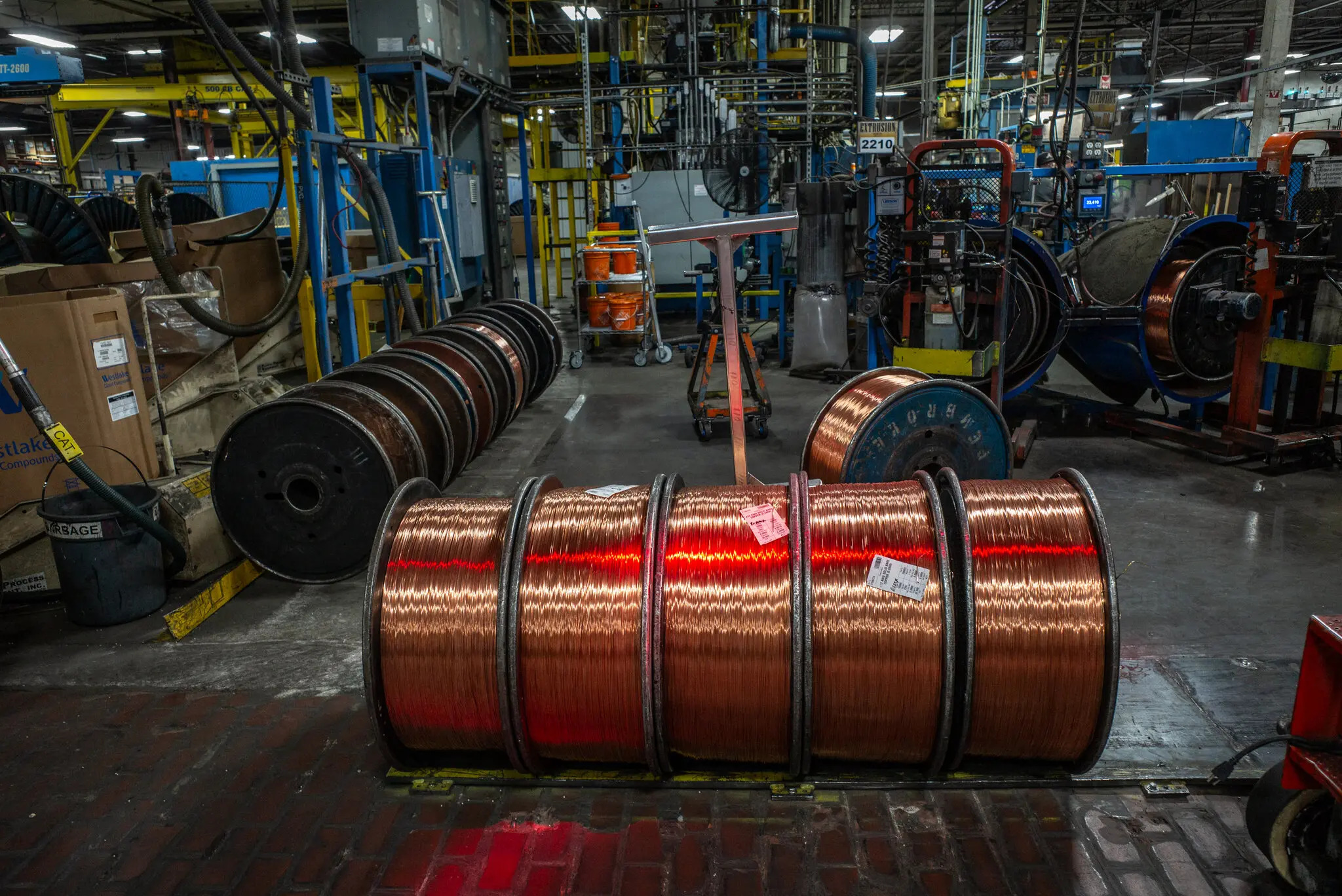 A half dozen large spools of copper wire.