

The Electronic Vehicle Supply Chain is Transforming our Economy – Are We Ready?
Electronic vehicles, lithium battery manufacturing and battery component assembling are a growing phenomenon across Ontario, one that is transforming our economy and our workforce. Over the past year the province of Ontario has attracted billions of investment dollars from leading global companies such as Stellantis, Umicore and Volkswagen into communities like Essex County, London-St. Thomas, Loyalist Township and Thunder Bay.
Through these new investments, we will see over 6000 new direct jobs with even more on the horizon. And why? Electric vehicles (EVs) are transforming the mobility sector to an extent not seen since the introduction of the Model T Ford. The marketplace—once uncertain about EVs—has reached a tipping point and will continue to grow as consumers seek more economical, environmentally-friendly transportation options. Global demand forecasts predict that EVs will grow sixfold from 2022 through 2030, Last year, global sales of electric vehicles hit $384 billion.
These opportunities have created new challenges domestically, for muncipalities and educational institutions. How will we manage these generational opportunities? To optimize this potential economic opportunity, we all need to understand and prioritize the important work before us. In the short term, we need to mobilize a labour force that embraces manufacturing work. This won’t be easy.
For example, one of the obstacles we in education must overcome occurred just recently in Eastern Ontario when manufacturers identified hiring and retaining workers as a primary constraint to growth and productivity. Adding to the problem, in their view, was that these workers need skills and capabilities to help their employers’ meet targets and maintain competitiveness. This will require higher education to seize the moment – with thousands of new jobs requiring new knowledge, processes, and procedures – thus requiring colleges and universities to pivot – just as they did in the post-Fordist branch plant economy.
The question then for us becomes: Is there the same optimism and motivation to engage global leaders in chemistry and automotive – harnessing new core competencies, manufacturing paradigms and management? Will new centers of excellence emerge and coalesce behind these multibillion-dollar capital expenditures? Manufacturers will need increasing support to maintain productivity and increase export opportunities.
One Organization Is Embracing The Challenge
Recently, the Smart Prosperity Institute, with support from the Future Skills Centre , published three reports that encourage the required transformation in Ontario. These reports offer guidance into skills needs for workers in Ontario’s growing zero-emissions vehicles and battery manufacturing sector. Moreover, they offer a plan for government, industry, and higher education to support workers in this transition. This Plan Includes:
The trouble is we think we have time -time to organize and adapt to these emerging opportunities while, at the same time, maintaining our standard of living and our place in the world – an increasingly doubtful combination. Political instability in Europe, resulting from the Russian invasion of the Ukraine, the high cost of energy (exacerbated by the destruction of the Nord Stream pipeline), and post-COVID interest rates articulating into the high cost of capital have provided a window of opportunity for Ontario to win globally. Although we have structural and new challenges – like all sales environments, you only have to be marginally better than your next closest competitor. And right now we are. We must, however, recognize that window will not stay open indefinitely and we – here in Eastern Ontario – will need to support the investments that have been made
Today our labour markets are tight. The unemployment rate is near 5%. New manufacturing jobs in non-metropolitan communities require immigration – often this means intraprovincial immigration. Net new immigration necessitates the building of new homes for workers. This critical task is proving difficult and a strategic approach has to date – proved elusive. Strategy is of course all about making choices and setting priorities. Purpose built housing for essential workers is a short-term requirement for the new economy. Like the war time housing of the 1940’s and 1950’s, this will require an all of government approach with municipal, federal and provincial collaboration. Not including industry in this
approach will be a mistake.
With No Vacancy: Housing Is Under Pressure
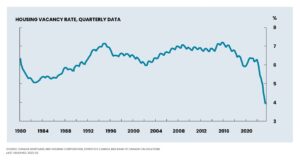
The post -COVID housing shortage has already negatively affected manufacturers’ productivity and ultimately their ability to drive optimal returns on capital. The province has set an ambitious goal of 1.5 million units to address the housing crisis. Housing workers in the electronic vehicle supply chain, like labour force availability and skill development will either keep Ontario on a winning trajectory or undermine our potential success. Municipalities will need to promote the building of purpose-built units that meet the specifications of essential workers – particularly the elements relating to physical layout and affordability.
Demographic Demand Has Far Outpaced Housing Construction In Recent Quarters
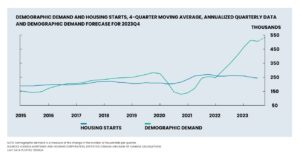
Given the cost of goods and mortgage rate increases, affordability has become an immense obstacle. It is incumbent on municipalities and provincial policy makers to develop plans that meet the needs of these essential workers. If we are to grow the economy and expand the social welfare apparatus, we need manufacturing to be thriving and essential workers expanding their incomes and their families., none of which they can do without affordable and available housing.
Eastern Ontario Continues To Experience Historically Low Housing Inventory
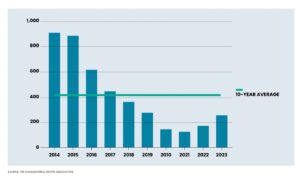
To be sure, this is a moment of promise. Action is required to underwrite and reduce the risk these massive global capital expenditures in the green economy present. Together we can write the next chapter in Ontario’s history of economic progress and global competitiveness. If, however, we falter in workforce mobilization, training, or housing, we will squander the opportunity of this generation.