



Find out why the St. Lawrence Corridor is the best place for your business to grow.


February 12, 2021 |
Impending pipeline closure will have far reaching negative consequences
Brockville, Ontario – February 12, 2021 – Brockville, Ontario – February 12, 2021 – Urgent action is needed by Prime Minister Trudeau to protect the interests, livelihoods and security of Canadians. In 12 short weeks, on May 12, 2021, Enbridge Line 5 will be forced to shut down by the state of Michigan, leaving significant energy shortfalls in Ontario and Quebec. This issue has gone under the radar for too long and the majority of Canadians do not even know that this energy crisis exists. It appears that this issue is not getting the attention it deserves from the Federal government.
In November 2019, Michigan Governor Gretchen Whitmer moved to revoke an easement that allows for the ongoing Enbridge Line 5 operations. The line is a critical energy artery for Ontario – its shutdown will have devastating effects on the provincial economy causing fuel shortages, increasing energy costs and creating massive job losses across the province. Energy shortages are a real concern for industry, but should also be a concern for the average citizen. Currently line 5 supplies about 45% of the petroleum refined in Ontario and Quebec. Ontario receives 540,000 barrels a day that is processed into gasoline, diesel and propane. To give an idea of the scale of this issue – Pearson airport relies on 100% of its jet fuel for Line 5. Moreover, from an economic development point-of-view this potential closing will lead to significant major disruptions in supply chains forcing rationing and ultimately driving up fuel prices for all businesses and the average citizen. Simply put, this line is critical for our daily lives and shutting it down will mean there won’t be enough fuel to look after our needs from personal driving, transportation of groceries and goods, heating fuel and the fuel needs of industry and farms. Of course, this will affect refinery jobs in places like Sarnia – which expects to lose almost 5000 quality high paying jobs but indirectly will affect an additional 23,500 jobs. Those jobs are held by real hardworking people. These jobs will be lost at a time that thousands of our neighbors, friends and family are already facing employment losses due to the pandemic.
There are no good solutions for solving for the energy shortfall through alternative sources. Transporting the same amount of crude oil and natural gas liquids as delivered by Line 5 would require 2,000 trucks or 800 rail cars going one-way each day. A recent study conducted on behalf of the State of Michigan found that alternatives to Line 5 would significantly increase the price of propane on both a wholesale and retail level and stress existing
transportation infrastructure. As Canadians the shadow of Lac-Megantic is still very much in our collective consciousness. More ships in the St. Lawrence Seaway hardly feels like an environmental victory!
Our organization’s mission is to attract industry and support the expansion of industry in Eastern Ontario. This issue of closing Line 5 imperils our safe and reliable energy security. Unfortunately, this has far reaching implications including 2 chilling effects that make this mission more difficult:
Media Contact:
Charlie Mignault
Commissioner St. Lawrence Corridor Economic Development Commission
613 893 2327
charlie@slcedc.com
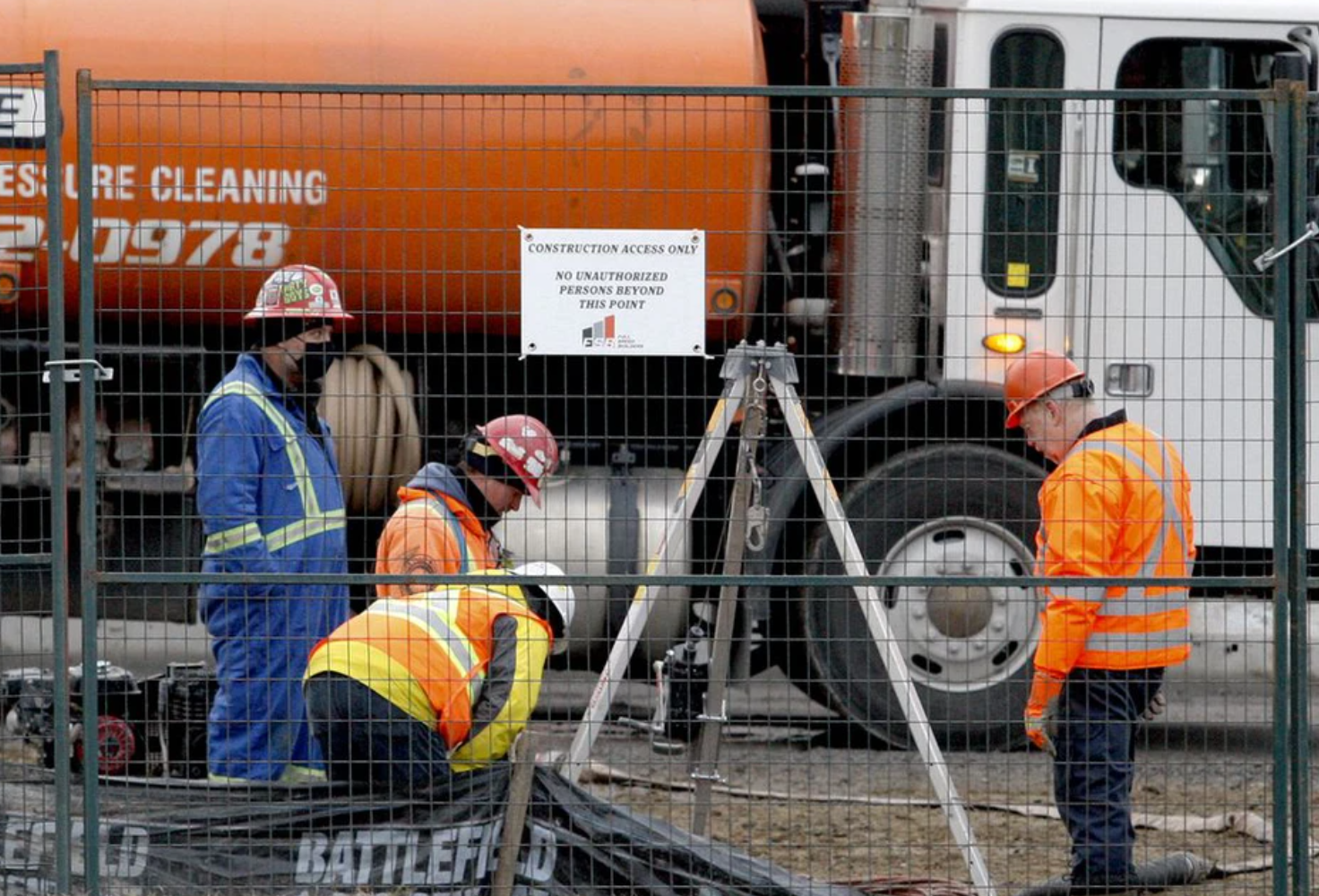
Brockville Recorder & Timea, December 14, 2020
As the COVID-19 pandemic devastated the global economy, it also taught Canadian businesses a stark lesson about the world supply chain, a lesson the region’s economic development commission won’t forget.
And the result has been local industries increasingly doing business with their neighbours, rather than with suppliers in other countries.
As the pandemic persisted from spring into summer, the St. Lawrence Corridor Economic Development Commission formed an industrial leadership team, bringing leaders of local industries together, touring each other’s plants.
The group began meeting every other month in mid-June.
Brockville Mayor Jason Baker, who is part of that group in his capacity as an owner of Ketchum Manufacturing, said it has enabled local business leaders to look outside their lanes.
“It’s been very interesting to watch one industry reach out to another and say: ‘I had no idea that you did that,’” said Baker.
“It’s a local collaboration that shortens the supply chain for industries and of course strengthens everybody’s operations and helps retain jobs,” he added.
The corridor commission brings together seven municipalities along the river to work together to attract and retain employers: Brockville, Prescott and the townships of Augusta, Edwardsburgh/Cardinal, Elizabethtown-Kitley, Front of Yonge and Leeds and the Thousand Islands.
The commission’s main objective is attracting new industries to the area, and commissioner Charlie Mignault said “re-shoring,” the return of manufacturing to North America from mainland China, remains a key avenue.
“The labour differential has been shrinking over the last decade,” said Mignault, adding robotics technology is cutting labour costs enough to start making up for the advantage of low Chinese labour costs.
Then came the “COVID stress test,” when the pandemic demonstrated how fragile a global supply chain can be, and how dependent Canada was on China in such sectors as health care and pharmaceuticals, said Mignault.
“What we saw in the first months was the shock to the supply chain,” he added.
The result is an acceleration of the re-shoring process, as Canadian firms tighten up that supply chain by bringing it closer to home.
In fact, the tightening was not prompted solely by China. In August, fears over the reliability of the personal protective equipment supply from the United States led to the expansion of Brockville’s 3M plant, which will soon manufacture N95 masks.
And within the corridor industrial leadership group, that has led to some happy discoveries.
The group has a dozen members, including such home-grown manufacturers as Canarm, Northern Cables and Newterra.
Mignault noted that Ross Video, which takes part even if it is technically outside the corridor, discovered that James Ross Ltd. north of Brockville, can manufacture engineered pieces for it that it has been sourcing from a company in Florida.
Similarly, Built Right, a manufacturer in Frankville, is able to work with Canarm in Brockville, said Mignault.
He added the corridor commission board is to meet on Wednesday to chart a course for 2021, hoping the arrival of a COVID-19 vaccine will signal a recovery later in the year.
Board members will discuss whether to continue on the current local consolidation course prompted by COVID, or flip back to a more full-scale focus on attracting industries by touting local advantages, said Mignault.
“We offer a solution to, say, the GTA or Montreal in that we have a very digitally-aware, well-educated workforce,” he said.
“We also have a strong price advantage. Our industrial land is extremely well-priced.”
As the Procter&Gamble plant winds down, local officials will work at marketing it to a potential new employer, even as skilled workers from that site remain, looking for new jobs.
And while the advent of robotics means any new manufacturer locating here will likely employ fewer people, “there’s definitely a job-creation play in this,” said Mignault.
“There’s less people per square foot on the floor, but we still know how valuable manufacturing is to an economy.”
That includes the people who do get jobs on that shop floor, but also ancillary work in the trades and logistics, added Mignault.
The commissioner is confident the new year will bring better news than 2020.
“I’m optimistic that we will get our fair share of new businesses coming,” he said.
Rzajac@postmedia.com
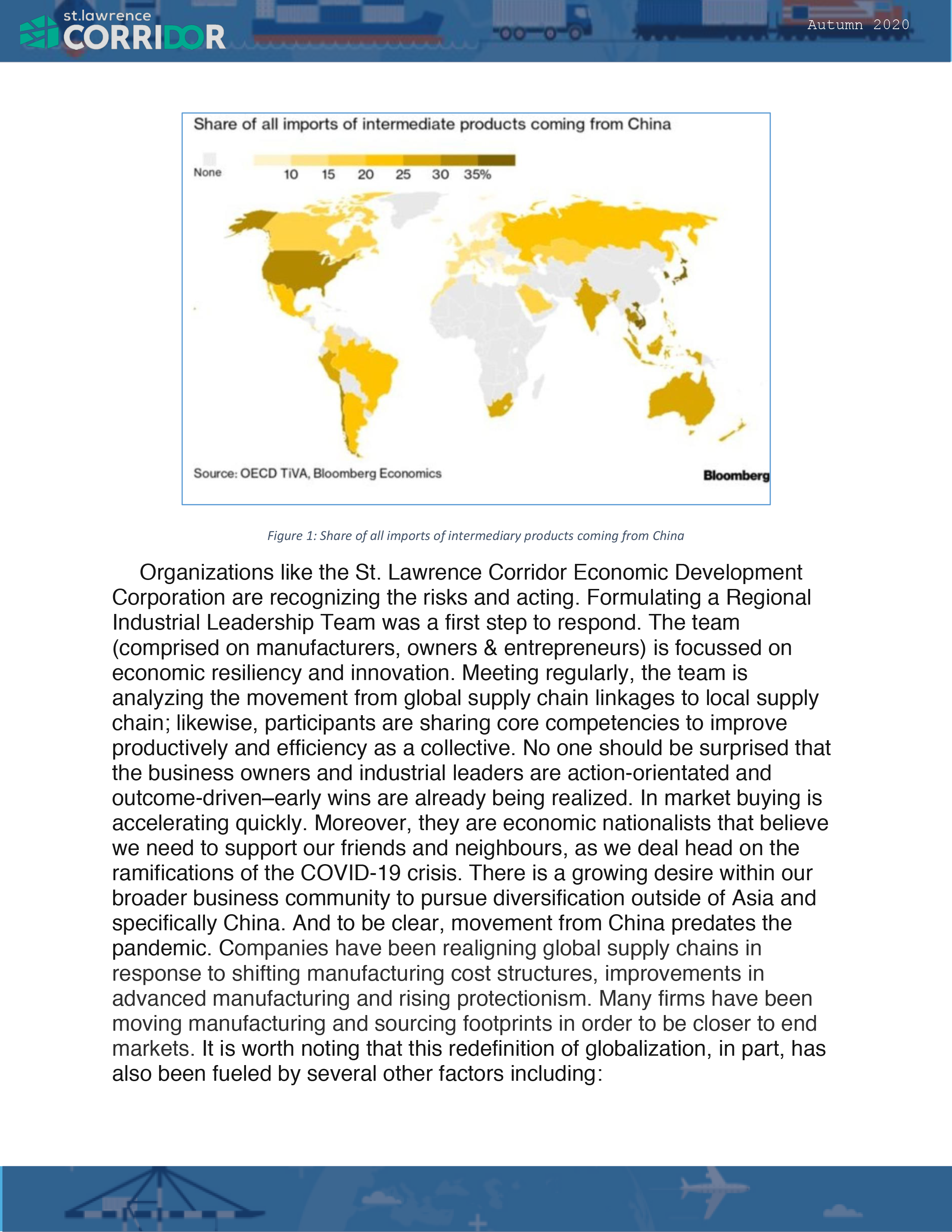
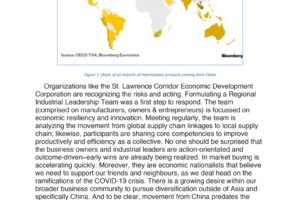
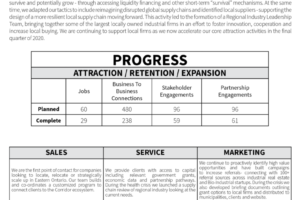
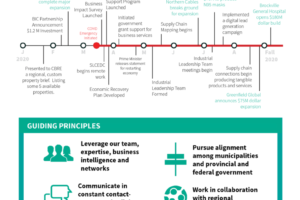
Organizations like the St. Lawrence Corridor Economic Development Corporation are recognizing the risks and acting. Formulating a Regional Industrial Leadership Team was a first step to respond to the new supply chain landscape.






Our business community is now going through what will be ultimately seen as a demarcation point in the way work gets done in Canada, and around the world. Over the past decade, there has been a gradual increase in the number of workers who work remotely. There have been a variety of economic and social reasons for this, all of which have no bearing on our current situation. As business leaders, as we move through this crisis, we have the opportunity to evaluate the impact and make longer-term, strategic decisions on how work gets done in our companies. Over the past decade the benefits of remote working have been well documented:
Financial Savings for Employees and Employers
Employees are More Creative
20% Productivity Boost
Lower Attrition Rates
As a business you are focused on impacting the current situation, long-term planning and strategy are not today’s thoughts. The time will come soon when we need to once again focus on the longer vision. Be prepared to evaluate the impact of remote work, we suspect this forced experiment will expose tremendous long-term positive impact. Support your employees who are working from home right now and put an analytical lens on the outcomes. What can you measure that will help guide your strategic decisions in the future. Hours worked is no longer a key measure of productivity, creative output is a much more valuable commodity and smart businesses will measure employee output from home differently.
Say goodbye to office hours, they are not coming back anytime soon

We are seeing two different approaches to consumer economic stimulus across North America. The Unities States is leaning towards a simplistic approach of putting money into the pockets of their citizens quickly and with little determination of need. The thought is to get liquidity into the consumer markets as soon as possible.
This approach differs from the Canadian stimulus package that mixes a variety of tax credits, adaptations of existing programs and loan relief. This is designed to stimulate the economy first through optimism, help those who need it most and then through impacting the broader economy. On the surface, it appears that the Canadian government is looking to mitigate the losses to the average Canadian and will worry about the broader economy through other means.
There is also a large difference in the message. The Canadian message is tangled in departments, applications and waiting period, the American message is that they are trying to mail a cheque.
The economic stimulus comes in many forms, impacting long-term and short-term market liquidity. It does appear that the Canadian package has significant benefits through providing liquidity to the broader economy through business, while the US hopes to inject immediate market impact through consumer liquidity and subsequent consumption.
Only time will tell what is the more effective measure and students will be studying this for years in Econ classes.
At the SLCEDC we are here to help, contact us today if you are looking for resources to fit your needs.

Find out why the St. Lawrence Corridor is the best place for your business to grow.
