As Canada ramps up its military spending, opportunities arise for local businesses and industries, a roundtable discussion heard last week.
Twenty-four industry leaders, primarily from the St. Lawrence Corridor, gathered on Jan. 19 at Prescott Town Hall for an industry roundtable on economic opportunities at the federal level.
The local leaders met with the Jenna Sudds, Parliamentary Secretary for the Ministry of Government Transformation, Procurement and Public Services, and Secretary of State for the Ministry of National Defence.
Hosted by David Beatty, chairman of Brockville-based Canarm, and Rhiannon Iles, President of HFI Pyrotechnics, located north of Prescott, the event brought together key stakeholders from industry, education, and job training services, organizers said.
The roundtable’s primary objective was to review opportunities arising from the “Carney Blueprint for Economic Growth and Defence,” specifically examining how local sectors can engage in, and realign business practices with, the government’s stated priorities.
“We could exchange, first hand, the opportunities and the challenges that lie ahead to leverage existing and forge new business practices,” said Sudds, the Liberal MP for Kanata, in a prepared statement. “These sessions are timely and needed.”
Organizers said the roundtable discussions touched on three main points, starting with the “Buy Canada Policy,” where Sudds outlined the new policy and the specific opportunities it creates for domestic industry.
They also discussed defence and dual-use technology. With Canada committing to its NATO spending targets, the roundtable explored strategic opportunities for industry within the defence sector.
Lastly, the topic of government support programs was talked through, where attendees were briefed on programs available through FedDev Ontario, particularly those introduced to support businesses affected by recent tariffs.
The session also included a dedicated question period facilitated by Beatty and Iles, allowing participants to address specific concerns regarding government engagement processes.
The event emphasized the critical link between industry readiness, educational alignment, and job training services in meeting the demands of these new federal initiatives, said organizers.
“Thank you for taking the time to discuss how Canada’s evolving economic and defence priorities can unlock new opportunities for industry-service open investments, jobs and regional growth, particularly for us SMEs,” said 401 Electric president Barry Moss, as quoted by event organizers. “We ended the session with a number of concrete next steps.”
Iles, one of the event’s organizers, says the roundtable was a success and she hopes to host another one in the future, potentially dealing with international trade.
“The roundtable generated a lot of energy for our company, HFI, to see what’s available and where we can leverage businesses and services locally,” she said in a statement of her own. “We want to have more of these, because we’ve heard loud and clear from our political contacts that getting MPs to the region to see what’s here is one of the best ways to influence engagement and increase visibility.”
Having a strong and reliable supply network is critical to keep any economy operating. In Ontario, that reliability comes from right here in the St. Lawrence Corridor. More than just a scenic stretch of land, the corridor is a vital transportation and trade network that ensures goods and materials flow efficiently, keeping businesses running smoothly in Ontario and beyond.
A Multimodal Powerhouse
Our regional advantages start with our strategic location and advanced multimodal infrastructure. The corridor boasts the St. Lawrence Seaway, a deep water marine highway with accompanying deep water ports, Canada’s busiest highway in the 401, and two of North America’s largest Class 1 rail systems in CN and CP.
St. Lawrence Seaway
The St. Lawrence Seaway is a critical element of the Corridor’s distribution eco system allowing goods to be transported both into Canada and the United States. It supports a significant portion of Ontario’s trade, with billions of dollars in cargo passing through annually. Additionally, the waterway is an environmentally friendly and cost effective way to transport large volumes of goods efficiently while cutting back on road congestion and emissions.
Highway 401
Highway 401, the busiest highway in Canada, serves as a crucial piece of infrastructure for ensuring goods are able to be transported rapidly to nearby major markets. This direct access to major urban centres such as Toronto, Montreal, and Ottawa, is a critical link for both crossborder and domestic business trade.
Railways
Our region boasts two of North America’s largest Class 1 railways systems in the CN and CP lines. These railways offer reliable and efficient ways to transport bulk shipments over long distances. This infrastructure helps businesses in the corridor connect to major markets and ports facilitating trade while reducing carbon emissions.
Fueling A Strong Economy
The Corridor’s role in the distribution industry isn’t just about moving products; it’s a major driver in our economy. Our efficient and modern infrastructure reduces operational costs which boosts competitiveness and allows for investment into local communities. This infrastructure combined with our strategic location makes the corridor an attractive hub for investment and business. The Great Lakes-St. Lawrence Seaway alone generates over 328,000 jobs in both Canada and the USA with over 181,000 of those jobs including over $26 billion in economic activity in Ontario and Quebec.
Looking Forward
As Ontario’s economy continues to evolve and grow, the Corridor remains at the forefront especially in the distribution industry. With new and ongoing investments in infrastructure and technology, the region is poised to become even more competitive and effective.
The St. Lawrence Corridor isn’t just any old location; it’s a testament to how strategic and integrated infrastructure can power the economy of an entire province. By leveraging our unique combination of road, rail and water transport, the Corridor will continue to be the driving force behind Ontario’s distribution industry moving forward.
The Brockville chamber of commerce’s top exec is optimistic about the challenges ahead. This is Part Two of Postmedia’s How Canada Wins series.
Pam Robertson is executive director of the Brockville and District Chamber of Commerce. (SUBMITTED PHOTO)
Editor’s note: This is Part Two in our contribution to Postmedia’s national series “How Canada Wins.” Over five weeks we are chronicling our community’s place in the country, the promise of greater prosperity, and the blueprint to get there.
The Brockville area’s business community has been tested twice in the past 10 years and has come out stronger, notes the executive director of the region’s largest business group.
Now, a third test has begun, and Pam Robertson, executive director of the Brockville and District Chamber of Commerce, thinks a more prosperous future lies ahead if area businesses band together like they did before.
Local economic leaders weathered the first tariff storm from a Trump White House in 2018, then the COVID-19 pandemic, and while the more sweeping tariffs imposed by the U.S. president this week are a cause for great concern, Robertson thinks “our business community is more savvy” this time around.
The previous trials taught the region’s business leaders to work more closely together, said Robertson, who has been the chamber’s executive director since 2015.
“We need to support one another and see if there are synergies in the supply chain, business to business,” she added.
This latest crisis has also brought opportunities for the kinds of action that will lead to a bigger, stronger local economy on this side of the river long after the tariff battles are just a moment in history, Robertson believes.
Provincial leaders finally appear serious about lowering interprovincial trade barriers, though Canadians have been talking about that for years, she noted.
“If we’re not supporting one another in our country, how can we really thrive?” said Robertson.
Movement on interprovincial trade barriers is encouraging, but other steps needed include greater investment in local infrastructure, and shoring up post-secondary education, now threatened locally by cuts to St. Lawrence College, she believes.
“I am optimistic, but it has to be really a focused energy to it, just as we saw during the pandemic,” said Robertson.
The Brockville and District Chamber of Commerce boasts more than 300 members, and acts as the area’s official “voice of business,” often lobbying local and senior levels of government on issues relevant to the business community.
The new Trump tariffs are an immediate and urgent matter, but more longstanding issues continue to hamper economic growth in the region.
The pandemic has increased the prevalence of remote work, and the region has plenty to offer someone who would prefer to work outside a larger centre, noted Robertson.
“To attract people, we need infrastructure, though, we need houses.”
In the latter case, she said, existing employers continue to struggle with a labour shortage exacerbated by the high cost of housing.
One positive start is the planned Campus Habitations development at Row’s Corners, which would create 140 rental apartment units geared toward the income levels of workers at local industries.
Such projects address the labour shortage and help grow the economy, said Robertson.
“If we have more people in our community, the tax base is bigger,” she said.
The Campus Habitations project remains in the planning stages as developers attempt to clear a bureaucratic hurdle at the provincial level, and figure out how to connect the proposed development to services, said Brant Burrow, mayor of the site’s host township, Elizabethtown-Kitley. Attempts to secure provincial funding for those service connections proved unsuccessful.
“Although tariffs and an unsettled world may be consuming everyone’s mental energy right now, housing challenges have not magically disappeared for anyone in the meantime,” Burrow said in an email to The Recorder and Times.
“It is the right solution, in the right place, at the right time. We just need to pull together to iron out a couple of remaining wrinkles, and clear the path to make it happen.”
Meanwhile, during the recent provincial election campaign, MPP-elect Steve Clark welcomed Brockville Mayor Matt Wren’s mention of reviving a community advisory body that would work with St. Lawrence College to design programs geared toward local workforce needs.
Robertson agrees it is crucial to shore up St. Lawrence College as it faces its current challenges.
College president and CEO Glenn Vollebregt blames those challenges largely on the federal government’s restrictions on international students, and Robertson insists those international students are needed, too – especially as Canada seeks skilled immigrants to make up for a declining birth rate.
“We need people from other countries to come into our country and to keep it thriving,” said Robertson.
The Brockville chamber of commerce recently announced that Shelley Bacon, CEO of Brockville-based manufacturer Northern Cables, is the latest recipient of its Lifetime Business Achievement Award.
Bacon also chairs the St. Lawrence Corridor Economic Development Commission, and he has some ideas of his own about how to achieve a more prosperous, vibrant economy.
“We do need much more domestic, Canadian-based manufacturing and business activities, where it’s homegrown,” said Bacon.
Shelley Bacon, head of Brockville-based Northern Cables and chairman of the St. Lawrence Corridor Economic Development Commission, is seen at the Brockville and District Chamber of Commerce Municipal Update breakfast on Tuesday, March 4, 2025. Photo by RONALD ZAJAC/The Brockville Recorder and Times
Canada, said Bacon, had “a very good run” in the manufacturing sector in the period between the Second World War and the era of free trade with the United States.
“The free trade deals in ’88 and ’94 basically closed all of the branch U.S. factories that existed in this country,” he added.
“Fortunately, we’ve had a number of industries across this country that have sprung up after that, a lot of private enterprises,” said Bacon.
“I think on a go-forward basis we need to see much more of that type of activity in this country, not to be looking for outside people, but for what we can do internally.”
That, of course, is the trajectory Bacon and his partners followed in the mid-to-late 1990s, when they created Northern Cables from the closure of the Phillips Cables plant in Brockville.
Reiterating a point made by fellow Brockville industrialist David Beatty of Canarm, Bacon believes these local manufacturers can work together to sell their products in conjunction with each other.
“We really should be looking internally (at) what we can do collectively together,” said Bacon.
When a local business decides to invest in growth, whether its a new product line, new/expanded facilities, or hiring more employees, the impact resonates far beyond that business’s walls. A single act of investment sets off waves of economic and social benefits throughout the community. All throughout the St Lawrence Corridor we have seen time and again how strategic local investment can transform communities, empower families, attract new opportunities, and more!
Dollars Spent Means Jobs Created
Every dollar a business spends locally whether it’s on materials, logistics, marketing or wages, circulates through the regional economy multiple times. A local manufacturer purchasing raw materials from a local supplier helps to expand the suppliers operations which in turn may lead to hiring more workers or upgrades in infrastructure. That business’s employees then spend their paycheques at local restaurants, stores, and service providers and the cycle continues. What begins as a simple business investment quickly becomes a chain reaction of economic stimulation. According to research from the Canadian Federation of Independent Business, money spent with a local business will recirculate in the local economy at nearly twice the rate compared to money spent at multinational chains. For municipalities along the Corridor, such as Brockville or Prescott, this means stronger, more resilient local economies.
Supporting a Skilled Workforce
Business investment often leads directly to job creation, and not just any jobs, good jobs. With the growth of industries such as clean technology, advanced manufacturing, and agri-food along the Corridor, there is an increasing demand for skilled workers. Investing in training, equipment, and facility upgrades help businesses tap into and further develop the local talent pool. When young people can see a bright future in their hometowns, whether through co-op programs, apprenticeships, or full time roles, they are much more likely to stay, build families, and contribute to their communities long term.
Enhancing Community Well Being
Local business growth often leads to enhanced public services, improved infrastructure, and more vibrant communities. Businesses engaged in their local community will sponsor events, partner with local schools, or support non profits, strengthening social bonds and regional pride. In the St. Lawrence Corridor, we’ve seen firsthand how local businesses can lead to revitalized towns, stronger communities, and increased opportunities for civic engagement. Business growth doesn’t just benefit the economy, it benefits our collective potential.
Attracting Further Investment
Arguably the most significant ripple effect of local investment is how it attracts even more investment leading to even more growth. When one company successfully scales up in the Corridor, it sends a clear signal to others that this is the place to grow. In turn, this momentum builds confidence among developers, investors, and entrepreneurs looking for promising locations with solid infrastructure, talent, and support. The St. Lawrence Corridor Economic Development Commission plays a crucial role in facilitating this cycle. By advocating for business friendly policies, connecting companies with funding and resources, and marketing the region’s strategic advantages, we help amplify every local investment to its fullest potential.
In Conclusion
Local business investment is a catalyst for growth. It fuels job creation, supports workforce development, enhances community well being, and lays the foundation for sustained economic growth. Along the St. Lawrence Corridor, we’re proud to support and celebrate the companies making investments in our shared future. When businesses succeed the whole region benefits.
The St. Lawrence Corridor has become a powerhouse for economic development, fostering an environment where businesses can thrive. As a key economic region in Eastern Ontario, the Corridor offers strategic advantages that support business growth, from access to transportation networks to a skilled workforce and robust infrastructure.
Strategic Location and Transportation Access
One of the biggest advantages of the St. Lawrence Corridor is its prime location. Situated along the St. Lawrence River, this region provides unparalleled access to major transportation routes, including Highway 401, rail connections, and deep-water ports. This connectivity enables businesses to efficiently transport goods across Canada and into the United States, making it an attractive hub for industries reliant on supply chain logistics and distribution.
Skilled Workforce and Talent Retention
A strong workforce is critical for business success, and the St. Lawrence Corridor delivers in this area. With proximity to several post-secondary institutions, businesses have access to a steady pipeline of skilled graduates. Additionally, local workforce development initiatives ensure that employees are equipped with the necessary training to meet industry demands, ensuring businesses always remain competitive.
Business Incentives and Support
The St. Lawrence Corridor Economic Development Commission (SLCEDC) plays a key role in supporting businesses by offering incentives, grants, and assistance with site selection. Companies looking to establish or expand operations in the area can benefit from support tailored to their needs, which includes access to funding opportunities, tax incentives, and connections to key industry partners. This pro-business approach helps to reduce barriers to entry and encourage economic growth in the region.
Thriving Business Sectors
The St. Lawrence Corridor is home to a diverse range of industries, including advanced manufacturing, logistics, agriculture, and technology. With a focus on innovation, businesses in the region are leveraging modern technology and sustainable practices to stay ahead in competitive markets. This dynamic business ecosystem fosters collaboration and growth, making the Corridor an ideal place for startups and established companies alike.
Community and Quality of Life
Beyond its economic benefits, the St. Lawrence Corridor offers an excellent quality of life. The region boasts beautiful waterfronts, vibrant downtown areas, a storm sense of community, and more, making it an attractive place to both live and work. Additionally, families benefit from excellent schools, healthcare facilities, and community programs that enhance overall well being. With its blend of economic opportunities and high quality of life the region stands out as an ideal destination for individuals and businesses alike looking to build a prosperous future.
What Are You Waiting For?
From the prime location and workforce to the economic incentives and a thriving business community, the region is well positioned to support businesses looking to grow. Whether you’re a new startup or an already established company with years in business, the St. Lawrence Corridor provides the resources, opportunities, and community needed to grow and prosper.
Are you considering a startup or business expansion? Connect with us today to explore how we can help achieve your business goals!
SPENCERVILLE ON, May 20, 2024 /CNW/ – The St. Lawrence Corridor Economic Development Commission is celebrating Potentia Renewables Inc. (Potentia) business achievement as the Skyview 2 Battery Energy Storage Project secures a ground-breaking contract with Ontario’s Independent Electricity System Operator (IESO). The project, a joint venture between Potentia and the Algonquins of Pikwakanagan First Nation, has been chosen to deliver 390 megawatts (MW) of battery energy storage capacity to the Ontario grid, marking the largest such project contracted in Canada’s history.
The Skyview 2 project, will be located in the Township of Edwardsburgh Cardinal, Ontario, recently received resounding support from the municipal council and is slated to commence operations in 2027. This initiative embodies a pivotal step towards a sustainable energy future, enhancing grid reliability and effectively balancing energy supply and demand for our region.
Key highlights of the Skyview 2 Battery Energy Storage Project include:
Project Name: Skyview 2 Battery Energy Storage Project
Project Owner: PR Development LP, an affiliate of Potentia Renewables Inc., and the Algonquins of Pikwakanagan First Nation
Technology: Lithium-ion energy storage facility (specific Lithium-Ion chemistry: Iron Phosphate – LFP)
Capacity: 390MW providing for 4 hours (1,560 MWh)
Land Use: Located on less than 30 acres of rural land (not prime-agriculture)
Number of Battery Containers: Approximately 400, each the size of a 20′ shipping container
Additionally, the project boasts several community-centric initiatives, including a Community Benefit Agreement with the Township of Edwardsburgh-Cardinal, promising $300,000 per year for community development. Furthermore, Skyview 2 is projected to contribute approximately $30MM in property taxes over its 30-year operational lifespan.
With its strong capacity and commitment to sustainability, the Skyview 2 Battery Energy Storage Project stands as a beacon of progress in eastern Ontario’s energy landscape, setting a precedent for future endeavors across Canada.
About Potentia Renewables Inc.
Potentia Renewables Inc. is a Canadian-owned renewable energy company headquartered in Ontario. With a portfolio encompassing 1.3 GWs of wind and solar projects across North America, Potentia is a leader in the field, embodying a commitment to innovation and environmental stewardship.
The St. Lawrence Corridor Economic Commission (SLCEDC) consists of six municipalities along the shores of the St. Lawrence River. Formed in 2017, the SLCEDC focuses on the attraction of new industrial and commercial employers to the region, increasing the quantity and quality of job opportunities for our residents The Corridor also supports the growth of existing scale ups in the industrial commercial sectors.
Quotes
Chief Greg Sarazin of the Algonquins of Pikwakanagan First Nation expressed pride in the partnership’s commitment to sustainable practices, stating, “Our partnership on the Skyview 2 Energy Storage Project represents a powerful step towards integrating sustainable practices that honor our ancestral lands while embracing modern energy solutions.”
Ben Greenhouse, CEO of Potentia, echoed Chief Sarazin’s sentiment, emphasizing the significance of the project in transforming energy storage and utilization. “This contract is not just a win for Potentia and its partners, the Algonquin of Pikwakanagan, but a leap forward for the industry in Canada,” Greenhouse remarked. “It reflects our commitment to innovation and our dedication to contributing to a sustainable future.”
Mayor Tory Deschamps welcomes this high impact project stating, “I am extremely excited for Edwardsburgh-Cardinal to become the future home of the SkyView 2 battery storage project. Potentia and partner First Nation Algonquin of Pikwakanagan will make excellent partners on this historic investment. Once open in 2027, SkyView 2 will ensure electrical grid stability, spur future investment and provide over a million dollars annually in revenue to the township. This project is only the beginning of many investments in the generational economic security of Eastern Ontario.”
Shelley Bacon the Chair of the St. Lawrence Economic Development Corridor Commission expressed his support of the initiative by Potentia and the Algonquins of Pikwakanagan. “We recognize the grid needs an enhanced level of support for both growth and risk mitigation. This forward-looking project may one day be the critical element in our electrical infrastructure – keeping homes, businesses and industry from freezing up during an extreme weather event. We, in the industrial sector across eastern Ontario, are only too aware of the constraints placed on manufacturing expansion simply because government has not yet invested in or expanded electrical infrastructure to our part of the province. We are hopeful this news is a first step in recognizing this unsustainable reality.
Charlie Mignault, Commissioner of the St. Lawrence Corridor Economic Development Commission agrees, “This is significant news for our entire region. The market for battery energy storage systems is growing rapidly. Clean energy investments will be a critical element in our regional economy moving forward. More than $5Billion was invested in battery storage systems in 2022 – a 300% increase over the previous year. We expect that globally the market will reach $120–$150 billion (USD) by 2030. We anticipate other elements of the battery value chain to follow such as the manufacturing of storage components including battery cells and packs and of their inverters, housing and other essential components in the balance of system. This market is at an explosive stage of development and we are very happy to have this investment in our Corridor region.
SOURCE St Lawrence Corridor Economic Development Commission
For further information: please contact: Charlie Mignault, Commissioner SLCEDC at charlie@slcedc.com
Electronic vehicles, lithium battery manufacturing and battery component assembling are a growing phenomenon across Ontario, one that is transforming our economy and our workforce. Over the past year the province of Ontario has attracted billions of investment dollars from leading global companies such as Stellantis, Umicore and Volkswagen into communities like Essex County, London-St. Thomas, Loyalist Township and Thunder Bay.
Through these new investments, we will see over 6000 new direct jobs with even more on the horizon. And why? Electric vehicles (EVs) are transforming the mobility sector to an extent not seen since the introduction of the Model T Ford. The marketplace—once uncertain about EVs—has reached a tipping point and will continue to grow as consumers seek more economical, environmentally-friendly transportation options. Global demand forecasts predict that EVs will grow sixfold from 2022 through 2030, Last year, global sales of electric vehicles hit $384 billion.
These opportunities have created new challenges domestically, for muncipalities and educational institutions. How will we manage these generational opportunities? To optimize this potential economic opportunity, we all need to understand and prioritize the important work before us. In the short term, we need to mobilize a labour force that embraces manufacturing work. This won’t be easy.
For example, one of the obstacles we in education must overcome occurred just recently in Eastern Ontario when manufacturers identified hiring and retaining workers as a primary constraint to growth and productivity. Adding to the problem, in their view, was that these workers need skills and capabilities to help their employers’ meet targets and maintain competitiveness. This will require higher education to seize the moment – with thousands of new jobs requiring new knowledge, processes, and procedures – thus requiring colleges and universities to pivot – just as they did in the post-Fordist branch plant economy.
The question then for us becomes: Is there the same optimism and motivation to engage global leaders in chemistry and automotive – harnessing new core competencies, manufacturing paradigms and management? Will new centers of excellence emerge and coalesce behind these multibillion-dollar capital expenditures? Manufacturers will need increasing support to maintain productivity and increase export opportunities.
One Organization Is Embracing The Challenge
Recently, the Smart Prosperity Institute, with support from the Future Skills Centre , published three reports that encourage the required transformation in Ontario. These reports offer guidance into skills needs for workers in Ontario’s growing zero-emissions vehicles and battery manufacturing sector. Moreover, they offer a plan for government, industry, and higher education to support workers in this transition. This Plan Includes:
The trouble is we think we have time -time to organize and adapt to these emerging opportunities while, at the same time, maintaining our standard of living and our place in the world – an increasingly doubtful combination. Political instability in Europe, resulting from the Russian invasion of the Ukraine, the high cost of energy (exacerbated by the destruction of the Nord Stream pipeline), and post-COVID interest rates articulating into the high cost of capital have provided a window of opportunity for Ontario to win globally. Although we have structural and new challenges – like all sales environments, you only have to be marginally better than your next closest competitor. And right now we are. We must, however, recognize that window will not stay open indefinitely and we – here in Eastern Ontario – will need to support the investments that have been made
Today our labour markets are tight. The unemployment rate is near 5%. New manufacturing jobs in non-metropolitan communities require immigration – often this means intraprovincial immigration. Net new immigration necessitates the building of new homes for workers. This critical task is proving difficult and a strategic approach has to date – proved elusive. Strategy is of course all about making choices and setting priorities. Purpose built housing for essential workers is a short-term requirement for the new economy. Like the war time housing of the 1940’s and 1950’s, this will require an all of government approach with municipal, federal and provincial collaboration. Not including industry in this approach will be a mistake.
With No Vacancy: Housing Is Under Pressure
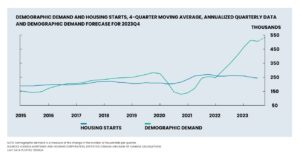
The post -COVID housing shortage has already negatively affected manufacturers’ productivity and ultimately their ability to drive optimal returns on capital. The province has set an ambitious goal of 1.5 million units to address the housing crisis. Housing workers in the electronic vehicle supply chain, like labour force availability and skill development will either keep Ontario on a winning trajectory or undermine our potential success. Municipalities will need to promote the building of purpose-built units that meet the specifications of essential workers – particularly the elements relating to physical layout and affordability.
Demographic Demand Has Far Outpaced Housing Construction In Recent Quarters
Given the cost of goods and mortgage rate increases, affordability has become an immense obstacle. It is incumbent on municipalities and provincial policy makers to develop plans that meet the needs of these essential workers. If we are to grow the economy and expand the social welfare apparatus, we need manufacturing to be thriving and essential workers expanding their incomes and their families., none of which they can do without affordable and available housing.
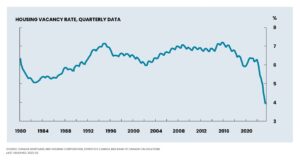
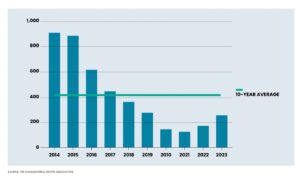
Eastern Ontario Continues To Experience Historically Low Housing Inventory
To be sure, this is a moment of promise. Action is required to underwrite and reduce the risk these massive global capital expenditures in the green economy present. Together we can write the next chapter in Ontario’s history of economic progress and global competitiveness. If, however, we falter in workforce mobilization, training, or housing, we will squander the opportunity of this generation.
Across Eastern Ontario we are dealing with a housing challenge. Affordability continues to remain an issue for young families and essential workers as prices in the region remain stubbornly high. Moreover, the housing supply remains at an all-time low. These issues are complicated by an aging population living in an aging housing stock that requires renovations and upgrades – all contributing to rising costs. This picture is made more complex with recent studies that suggest approximately 14% of adult children are still living at home.
Regional manufacturers have over 600 open jobs. These jobs – unfilled – effect productivity, exports, future expansion and investment. Real opportunity exists to solve the problem. There is an intraprovincial migration movement of people in their 30s from the GTA, Peel and Ottawa to Eastern Ontario. These people need housing and we desperately need essential workers.
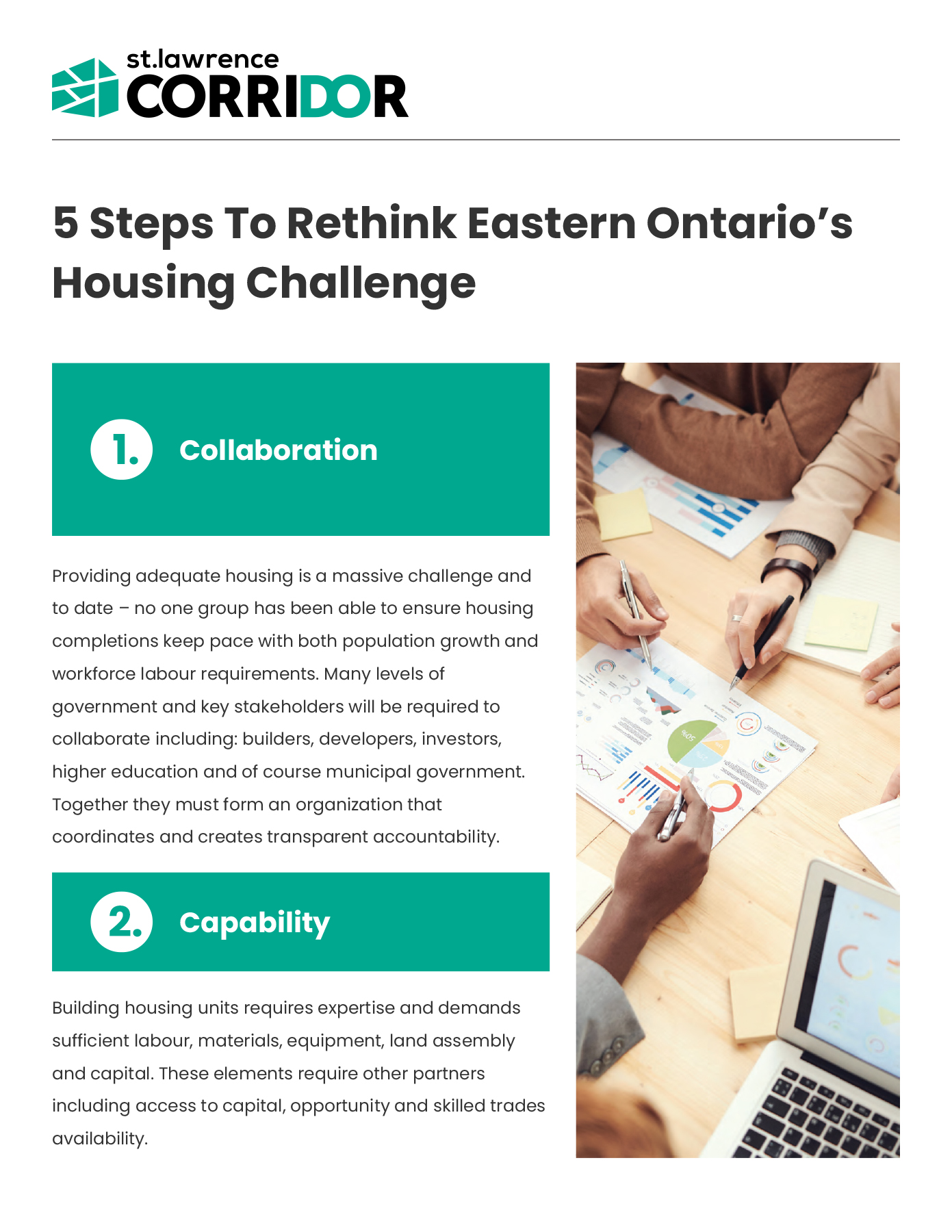
Much can be done regionally. Our local governments are working towards solutions. How can we support the development of purpose build housing? We need progressive policies that induce housing development. Zoning and land use regulations that will impact both availability and affordability. Policies and platforms that support the development of affordable housing or the even distribution of housing options across the region. Here are 5 ways we can improve residential housing development that will improve the environment and induce new development and future prosperity of Eastern Ontario.
Business leaders are sounding the alarm on the need for more housing as Brockville council prepares to make a key decision on a controversial development.
In a letter to council that specifically cites the Phillips Cables project, the St. Lawrence Corridor Economic Development Commission warns as many as 700 new jobs are at stake if more housing is not built quickly.
“Our labour force analysis highlights a full-employment economy. Typically, this would be a good news story – but has a negative double edge,” notes the correspondence to council, signed by Charlie Mignault, the organization’s commissioner, and Shelley Bacon, head of Northern Cables and the commission’s board chairman.
The @SL_Corridor had a big start to 2022. A record-breaking start. We smashed existing records for new investment – welcoming more than $130 million in new investment and 269 new jobs. Please read our Mid-Year Report.